Defending Paul's High Christology in Philippians 2:5-8 against Kenotic Interpretations
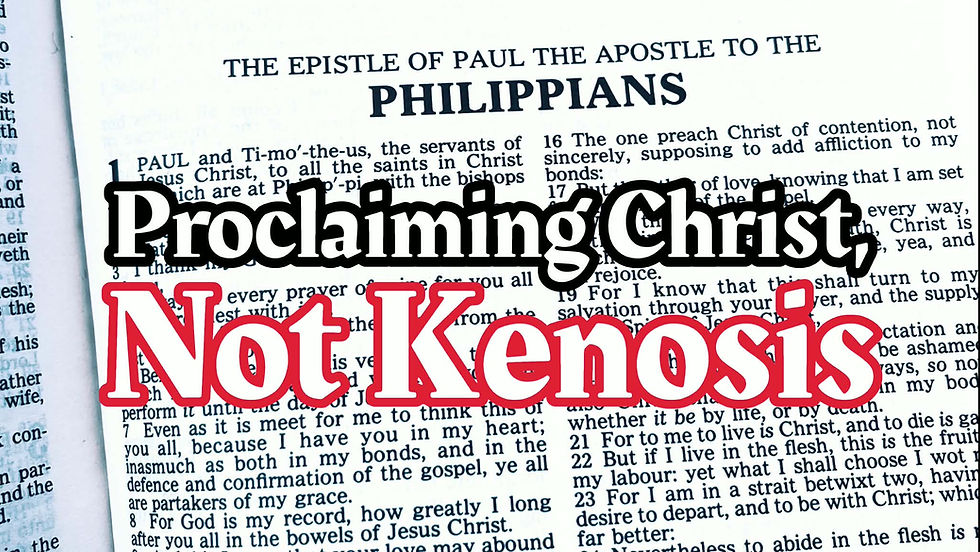
The following Christological exegesis of Philippians 2:5–8 is excerpted from my book, Polemical Apologetics: How to Defend Sola Scriptura Amid Anti-Christian Attacks (by Sonny Hernandez). Before reading the succinct exegesis of Philippians 2:5–8 below, it is vital to understand why a high Pauline view of Christology in these verses is critical. Rather than safeguarding the bodily existence of the Son as truly God, ill-advised readers often presuppose a perspective that diminishes Christ's coessential divinity. For example, in an October 3, 2024 message titled "How Do I Explain the Trinity? – Part 1," Scott Hand, a pastor at Parkwood Baptist Church in Gastonia, North Carolina, stated that Paul's message "clearly teaches that Jesus laid aside his divinity to come to Earth to be born in human form." Yet, a plain reading of this passage reveals no mention of Christ laying aside His deity—nor does any other biblical text—which demonstrates that Hand’s interpretation is unbiblical. Therefore, the following exegesis examines how to correctly interpret Philippians 2:5–8 in light of such kenotic and sub-kenotic misconceptions.
A High Christological Defense of Phil. 2:5-8 against the Kenotic View of kenoō
Christology is at the heart of the biblical gospel, emphasizing both the person and the work of the Son, God the Logos, and His two distinct, yet inseparable natures. For instance, John's use of the imperfect ēn ("was," v. 1) and the root ginomai ("made," v. 14), undeniably proves two unmingled natures—truly God and truly man without sin—in one person [hypostatic union]. And, "It is finished" in John 19:30 accentuates the completed work of the Son on behalf of the elect. As a perfect verb, the root teleō linguistically describes Christ's once-and-for-all saving work at the cross, without the need for it to occur again. As such, Scripture defines, defends, and declares Christology.
In defense of the two-natured person of the Son, this chapter will present a concise exegesis of Philippians 2:5-8, from a high Christological perspective. It will also explain the dangers of neglecting a sound model of interpreting Christological texts amid kenotic and sub-kenotic attacks. First, let's examine the dangers.
Dangers
a. Kenotic Theology
Attacks on the doctrine of Christ are inevitable. Historically, the treatment of the Greek verb ἐκένωσεν [root κενόω; transl. kenoō; lit. "emptied"] in Philippians 2:7 will reveal the culprits, namely, kenotic theologians. In short, kenotic theoreticians believe that the root verb kenoō denotes that the Son laid aside His divinity or experienced a deprivation of the divine attributes.
In addition, counterparts to kenotic theology, also known as sub-kenotic ministers, assert that he had possession of the divine attributes but either did not use them or did not use them independently, or had only restricted access to His deity. To call these kenotic and sub-kenotic views "absurd" would be an understatement, as Philippians 2:7 does not stress the extent of kenoō to imply the divestment of Christ's deity or the laying aside of His divine attributes.
b. Bad Translations
Bad translations also play a significant role in slanting the meaning of the root verb kenoō in Philippians 2:7. For example, the New Living Translation (NLT) reads, "Instead, he gave up his divine privileges…" (bold emphasis added). Strangely enough, in the phrase "divine privileges" in the NLT, "divine" serves as an adjective, but "privileges" functions as a noun. Yet, the GNT uses a conjunction all + reflexive pronoun eauton + verb ekenosen [lit., "But He emptied Himself"]. As a result, instead of appealing to favored, easy-to-read translations or what a popular pastor opines about the reading of the NLT, it is incumbent upon the saints to seek sound contextual exegesis to rightly divide the Word.
c. Poor Translators
Ill-advised preachers, not knowing the whole counsel of God, fail on many accounts to accurately describe a proper translation of the root verb kenoō [κενόω] or "emptied" in Philippians 2:7.
Another issue, most notably, is that many fail miserably to contrast verbs and will appeal to passages concerning His humanity but ignore texts related to Christ's full deity. For example, John 1:14 reads: "And the Word was made flesh..." (bold emphasis added). Without a doubt, this verb ("made") refers to Christ's assumption of His human nature at the beginning of His conception and manifest in His earthly pilgrimage. However, it does not imply that the person of the Son’s coming into existence as a created being. It is the humanity of Jesus that had a beginning. In Isaiah 9:6, this is clear as “unto us a child is born, unto us a Son is given” because the eternal Son always existed, as noted in John 1:1: "In the beginning was the Word, and the Word was with God, and the Word was God" (bold emphasis added). As an imperfect verb, ēn ("was") denotes the Son's eternality and continuous existence as God. A failure to address both verbs, "made" and "was", will result in, at best, unorthodoxy, and at worst, heresy.
To further explain, many do not believe that the Son exercised and possessed all the divine attributes during His incarnate ministry because Scripture states, "But of that day and hour knoweth no man..." (Matt. 24:36), "Jesus increased in wisdom and stature..." (Luke 2:52), and "Jesus said, 'Who touched me?'" (Luke 8:45). Yet, many ignore how Christ described His presence on earth and heaven simultaneously (omnipresence) in John 3:13. Far too many forget that the disciples told Jesus, "thou knowest all things" (omniscience) in John 19:30. As far as His omnipotence is concerned, Scripture unmistakably underscores the Son's equality with the Father (Luke 10:22; John 5:17-23; 10:33).
Undoubtedly, many will appeal to passages concerning His humanity, but will ignore the texts on Christ's deity. Arians condone this practice, as they think Christ is a created being, and not in every way God. Conversely, when some favor texts related to Christ's full divinity and neglect passages concerning His humanity, their approach is similar to the Docetists, as they reject the Son's true humanity. Rather than trying to pit incarnational texts against divinity passages or favoring one over the other, the true sheep or elect of God will embrace both, because Christ is both truly God and truly man.
When kenotic theologians treat Paul's use of the root kenoō in Philippians 2:7 as the laying aside or the restriction of His deity, they seemingly think the apostle's message in Philippians 2:7 conflicts with his teaching in Colossians 2:9. In Colossians 2:9, Paul's inclusion of the root katoikeō [κατοικεῖ] or "dwells," a timeless present, describes what permanently abides in Christ. To explain what continually dwells in the Son, Paul referred to the "fullness of the Godhead" or deity, and included the adverb sōmatikōs or "bodily," thus indicating the incarnation. After examining this exegesis, it is clear that Paul never wrote, "For in him dwelleth only restricted access to the fullness of the Godhead bodily." Instead, Paul's defense of the full deity of the incarnate Son was at the forefront of his mind, as it was in Philippians 2:5-8. In the GNT, the original reads as follows:
A Brief Exegesis
[5] Τοῦτο γὰρ φρονείσθω ἐν ὑμῖν ὃ καὶ ἐν Χριστῷ ᾿Ιησοῦ, [6] ὃς ἐν μορφῇ Θεοῦ ὑπάρχων οὐχ ἁρπαγμὸν ἡγήσατο τὸ εἶναι ἴσα Θεῷ, [7] ἀλλ᾽ ἑαυτὸν ἐκένωσε μορφὴν δούλου λαβών, ἐν ὁμοιώματι ἀνθρώπων γενόμενος, καὶ σχήματι εὑρεθεὶς ὡς ἄνθρωπος [8] ἐταπείνωσεν ἑαυτὸν γενόμενος ὑπήκοος μέχρι θανάτου, θανάτου δὲ σταυροῦ.
5 Let this mind be in you, which was also in Christ Jesus: 6 Who, being in the form of God, thought it not robbery to be equal with God: 7 But made himself of no reputation, and took upon him the form of a servant, and was made in the likeness of men: 8 And being found in fashion as a man, he humbled himself, and became obedient unto death, even the death of the cross.
a. Verse Five
Paul was not shy about including pronouns at the beginning of Philippians 2:5-7. In these texts, the apostle used a demonstrative [Gk. Τοῦτο; Eng. "this"], a relative [Gk. ὃς; Eng. "Who"], and a reflexive pronoun [Gk. ἑαυτὸν; Eng. "himself'], as all three either point to or highlight several Christological truths. Starting with the first, the beginning of verse five reads, "Let this mind be in you..." (bold emphasis added). Paul's use of the neuter demonstrative Τοῦτο refers to previous texts (vv. 2-4). To put it simply, in this verse, since Christ is the ultimate standard of humility, the apostle commanded the saints to emulate the characteristics of the Son.
b. Verse Six
Next, Paul used a relative pronoun at the outset of one of the most profound, theologically rich, Christological texts in the Bible, specifically Philippians 2:6: "os en morphē theou uparchōn oux arpagmon ēgēsato to einai isa Theo" ("Who, being in the form of God, thought it not robbery to be equal with God," bold emphasis added). As a relative pronoun, os or "who" (v. 6) points to Jesus (v. 5), as both agree in gender (masculine) and number (singular). This grammatical explanation accounts for a basic rule of Greek grammar, as "The relative pronoun always agrees with its antecedent in gender and number" (McLean, New Testament Greek: An Introduction, p. 79).
After reading verse six, it is no surprise to see the apostle's defense of the full deity of the person of the Son with his use of uparchōn [ὑπάρχων]. As a present-tense participle, uparchōn or "being" denotes His continuous existence, and ultimately means "continuing to be" what He has always been. When examining this verse, contrast the verb "being" [uparchōn] in verse six with the root verb ginomai ("was made") in verse seven. In the former, "being" stresses the incarnate Christ's "continuing condition" (Kent, Philippians, in The Expositor's Bible Commentary, vol. 11, p. 123). Still, in the latter, "was made" points to the incarnation (He already assumed His human nature). To put it another way, per the context, before He "was [already] made in the likeness of men" (v. 7, emphasis mine), the incarnate Son always existed as the one "being in the form of God" (v. 6, emphasis mine). As such, these texts prove the deity and eternality of the Son both before and after the incarnation.
Moreover, the root morphē or "form" denotes the Son's "essential attributes" (Lightfoot, St. Paul's Epistle to the Philippians, p. 110), and is a declaration that He possesses "the whole fullness of attributes which make God God" (Warfield, The Person and Work of Christ, p. 39). Again, contrast Paul's use of the root morphē in verse six ("form of God") with verse seven ("form of a servant"). As a result, it is clear that the incarnate Christ always existed in the "form of God" before taking the "form of a slave" (having [already] taken the form of a servant). And, the eternal Son's existence in the "form of God" is true before "He emptied Himself" (v. 7).
In the last clause of Philippians 2:6, "...thought it not robbery to be equal with God" refers to "something Christ possessed and chose not to exploit, not something He lacked and chose not to acquire" (Hellerman, Philippians: Exegetical Guide to the Greek New Testament, p. 110). Since He shares the same divine nature with the Father and the Holy Spirit, Christ did not consider it robbery to be equal with God, because He has always been and will always be God. Ultimately, Christ cannot stop being who He has always been.
c. Verse Seven
Regarding Philippians 2:7, in the opening, Paul once again used a pronoun, specifically a reflexive pronoun, eautoun [Gk. ἑαυτὸν; Eng. "himself"]. Clearly, this pronoun denotes a voluntary act. To prove this point, while the context proves that Christ is the subject of the root verb kenoō ("emptied"), the reflexive pronoun "himself' [eautoun] is the object [accusative case], as "Reflexive pronouns do not possess nominative forms because they specify a verbal action that refers back to the subject" (McLean, New Testament Greek: An Introduction, p. 80). Per this explanation, Christ is the subject of "emptied," and "himself" [Christ] is the object of this verb.
Now, it is time to address the Greek verb ἐκένωσεν [root κενόω; transl. kenoō; lit. "emptied"] in Philippians 2:7. What is the extent of this verb? Most commonly, many scholars and pastors believe that Christ emptied Himself by becoming flesh. Not surprisingly, most scholars hold this view because the participle labon ("and took upon him") immediately follows the verb kenoō ("emptied"). As a result, many exegetes interact with labon as a participle of means, and thus think that the clause "took upon him the form of a servant, and was made in the likeness of men" was the means by which Christ emptied Himself. This view overlooks the context, as Christ's assumption of His human nature had already occurred. Thus, "In the words ‘emptied Himself,’ Paul is suggesting that the Incarnate Christ is to pour out (emphasis added) his life (having [already] taken a position of a servant and having [already] taken the likeness of humanity) in death" (Zachariades, Kenosis, in Holman Illustrated Bible Dictionary).
Equating the verb kenoō with Christ becoming flesh and describing labon as a participle of means is inaccurate because the context of Philippians 2 suggests that the eternal Christ had already become flesh. Per the context, it is best to present labon as "a participle denoting antecedent action, thus placing Christ's 'self-emptying' subsequent in time to the 'taking'" (Reymond, A New Systematic Theology of the Christian Faith, 2nd Ed., p. 263). Thus, Christ did not empty Himself by means of taking upon the form of a servant. Instead, labon denotes "a prior action that was the necessary precondition to the 'self-emptying'" (Ibid.). Therefore, Paul's use of the root kenoō in Philippians 2:7 points to His voluntary death, and is the fulfillment of the Isaianic phrase: "he hath poured out his soul unto death" (Is. 53:12). Put another way, "poured out his soul unto death" stresses the extent of the verb ἐκένωσεν, as Christ voluntarily emptied Himself by His obedience "unto death, even the death of the cross" (Phil. 2:8).
d. Verse Eight
Furthermore, in verse eight, Paul's emphasis on the root schēma or "fashion" indicates "the generally recognized state or form in which someth. appears, outward appearance, form, shape" (BDAG, A Greek-English Lexicon of the New Testament and Other Early Christian Literature, 4th ed., p. 872), or "what He appeared in the eyes of men" (Lightfoot, St. Paul's Epistle to the Philippians, p. 112).
Lastly, "...he humbled himself, and became obedient unto death, even the death of the cross," means the Son emptied Himself or poured out His soul by His penal obedience or death at the cross, having already taken the form of the servant. With respect to the Trinity, Christ died for precisely those whom the Father had given to Him, and the Spirit will seal all of the elect of the Father for whom the Son died. And Christ's death is unparalleled because He redeemed the elect from the thralldom of Hell. As the Savior, His finished work is the ground of justification, and the only righteousness assuring the saints of salvation.
Closing
After reading this chapter, it should be clear why having a sound, high Christology is essential to refute the kenotic and sub-kenotic camps, where unscrupulous individuals think the Logos either divested Himself of divinity, laid aside His deity, or mistranslate the meaning of kenoō in Philippians 2:5-8. God's elect must define, defend, and declare Philippians 2:5-8 accurately to the glory of the Triune God alone.


Comments